This week, I’m turning back the clock to the late 1970s and the feature film debut of Hayao Miyazaki: Lupin III: The Castle of Cagliostro (1979).  Though of course I’m a fan of several of his later films under Studio Ghibli, I’m surprisingly poorly versed in his earlier work, and this classic had somehow escaped my attention. With it recently resurfacing on Netflix UK, when better to give it a chance? Cagliostro follows master thief Lupin and his accomplice Jigen as they trace the source of counterfeit bank notes to the titular castle in the Principality of Cagliostro before getting involved in breaking up the forced marriage of the kingdom’s young princess to its evil count.
Continue reading “Review: Lupin III: The Castle of Cagliostro (1979)”
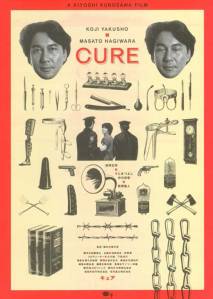 Kiyoshi Kurosawa is a fairly prolific director and, at the time of writing, I have only seen four of his many films. His work seems to be getting some new attention here in the UK with a slew of releases from Arrow Video and Eureka! Masters of Cinema. The latest entry is
  Loosely picking up where
  Bunta Sugawara stars as Kuroda, a wanderer who takes the fall for a murder on the understanding that when he gets out of jail, the Owada crime family will take him on-board and pay handsomely for his service. When his heroin junkie contact (Tsutomu Yamazaki,
 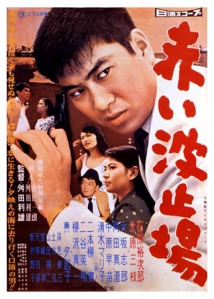 It stars Yujiro Ishihara as “Lefty” Jiro, a ‘50s gangster laying low in Kobe after killing a civilian over a drug smuggling racket. When he falls for the victim’s sister and starts to let slip his involvement, his low-key criminal underworld starts to come unravelled.
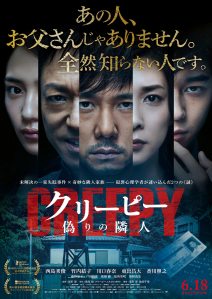 leaves his job hunting serial killers to become an academic specialising in criminal psychology, but when his new job is unfulfilling he re-opens the cold case of a missing family on the side. In a parallel story, his wife becomes perturbed by their unusual new neighbour Nishimoto (Teruyuki Kagawa). But as Takakura tells his wife – serial killers are usually nice to their neighbours, so she has nothing to fear from the socially graceless Nishimoto. Right?
 so here’s
 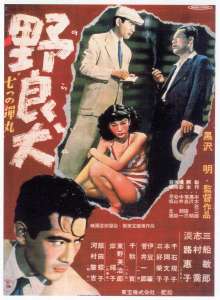 That could seem like a reductive description, but
 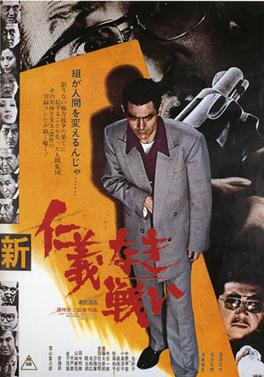 After the success of those films, Toei apparently felt the same way: they wanted Fukasaku to create more sequels. Instead, the director created a new three-film anthology – different stories, different locations, and different characters, but with many of the same actors from his original series. The first film,
  fabulous Bubble-era tax evasion/enforcement comedy
  Kino 893