
Director Shunya Ito returns with his final entry in the Female Prisoner Scorpion series with Female Prisoner Scorpion: Beast Stable (1973). Loosely picking up where Jailhouse 41 left off, Meiko Kaji’s escaped convict Matsushima, aka the titular Scorpion, is on the run and still doggedly pursued by the police. Taking place largely outside of any actual prison and in an urban setting would already give the movie a different feel to its predecessors, even Jailhouse 41 that also prominently featured an escape attempt, but Ito also gives Beast Stable a far stranger, more horror-oriented tone than his earlier entries. At times, it feels more like watching something as surreal as Blind Woman’s Curse – not coincidentally, also starring Meiko Kaji. So different is the tone that in the back of my mind I knew that Ito didn’t direct all four Female Prisoner Scorpion movies and I found myself wondering if this, and not the final #701’s Grudge Song, was the movie he skipped.
Continue reading “Review: Female Prisoner Scorpion: Beast Stable (1973)”
 Bunta Sugawara stars as Kuroda, a wanderer who takes the fall for a murder on the understanding that when he gets out of jail, the Owada crime family will take him on-board and pay handsomely for his service. When his heroin junkie contact (Tsutomu Yamazaki,
  challenge: at the end of the first film in each,
  The directorial debut of Shunya Itō, starring Meiko Kaji,
 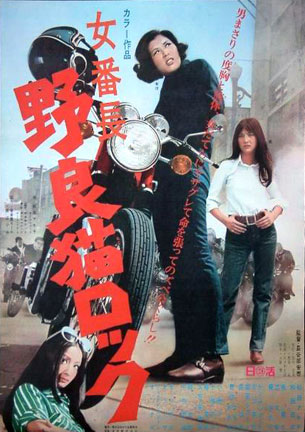 ded as a star vehicle for the popular singer Akiko Wada, from the second film onwards it would be Kaji who scored top billing, and Wada soon disappeared from the cast. Going into the film, I expected it to be a case of Meiko Kaji outshining the intended star – after all, by this point I had already been impressed with her performance in
  an aggressively strange yakuza movie with a touch of the supernatural. It’s so strange the Arrow Video release calls it ‘delerious’ multiple times on the cover, and for once, that doesn’t feel unfair – from the bold use of colour to the costuming to the off-kilter horror elements, the film is a phantasmagoric treat.
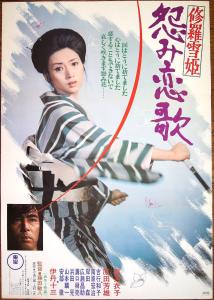 satisfying take on the
  horizons on Japanese cinema, one of the main reasons I want to watch films from the ’50s, ’60s, and ’70s is their outsized influence on later filmmakers. Quentin Tarantino is outspoken on the influence Japanese cinema has had on his pictures, with
  Kino 893