Back in the early 2000s, Kinji Fukasaku’s Battle Royale was probably one of the first live action Japanese films I ever watched. Its popularity helped highlight other Japanese cinema, and a for while, Japanese films were synonymous with shocking, violent pieces like Battle Royale or the work of prolific director Takashi Miike – slapstick exploitation like Ichi the Killer or the truly bizarre Happiness of the Katakuris. It moved the conversation away from the ubiquitous J-horror of the late ‘90s, led by Ring and Grudge and their imitators. Of course, there’s much more to Japanese cinema than that, but it’s where I got my start. It wasn’t until many years later that I became interested in throwback yakuza movies of the 1970s, largely off the back of my interest in SEGA’s Yakuza/Ryū ga Gotoku series. The title I kept seeing referenced as Japan’s equivalent of the Godfather trilogy was Battles Without Honour and Humanity, directed by none other than Kinji Fukasaku.
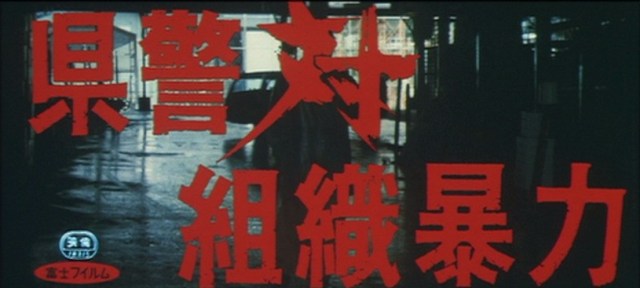
That series remains perhaps the most well-known example of the “jitsuroku” style of yakuza filmmaking – ‘actual record’ or ‘true document’ films, based on or inspired by real stories or newspaper headlines; films that didn’t depict the yakuza as masculine heroes on the wrong side of the law, but focused on petty squabbles, violence, and a nihilistic take on Japan’s organised criminals. It was between the five-film Battles Without Honour and Humanity saga and its follow-up, New Battles Without Honour and Humanity, that Toei’s top brass brought Fukasaku in to direct Cops vs. Thugs (1975). Not content to deconstruct the yakuza alone, the film drags the police and civic leaders into a fascinating quagmire of corruption.
 Like a few of the other Japanese gangster movies I’ve reviewed here on Kino 893, it’s a title that
  That means the quality and availability of Japanese films with English language subtitles (ignoring for a moment the often very fine work of fansubbers) is not necessarily representative of the quality or breadth of Japanese cinema in general. This is even more true when looking back at older films; while a contemporary film might at least get a limited release in the West, older films by lesser known directors or even by well-respected auteurs can be difficult to find. Even
  an aggressively strange yakuza movie with a touch of the supernatural. It’s so strange the Arrow Video release calls it ‘delerious’ multiple times on the cover, and for once, that doesn’t feel unfair – from the bold use of colour to the costuming to the off-kilter horror elements, the film is a phantasmagoric treat.
 satisfying take on the
 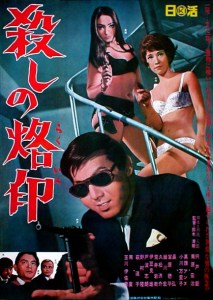 Specifically, it was an anecdote about his film Branded to Kill (1967): a film so far removed from his orders to create a B-movie about a hitman, to fill out the back half of a double bill, that he was promptly fired by the studio. The movie is now regarded as an avant-garde masterpiece, and I knew that I had to see it.
 series. After all, I was treating them as B-movies between the films of Akira Kurosawa: not just one of Japan’s most acclaimed directors but one of the most acclaimed directors of all time. Funny story: the first Outlaw film was directed by Toshio Masuda who, along with Kinji Fukasaku and Richard Fleischer, directed Tora! Tora! Tora! Masuda and Fukasaku were brought in to direct the Japanese side of the production after Kurosawa dropped out. While Keiichi Ozawa directed most of the other instalments, for Heartless, Mio Ezaki took the reigns.
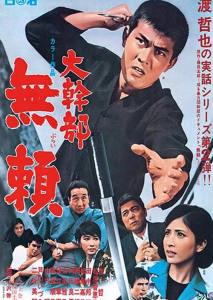 a series of amazing revelations. First, that really is the title (at least the one Arrow Video decided to go with). Second, it came out in April 1968, just a few months after the first movie. Third, no less than five movies in this series came out in 1968 – it’s almost a shame the sixth skids into 1969, but that’s a movie for another day. Fourth, these movies are almost impossible to research: there aren’t even Wikipedia art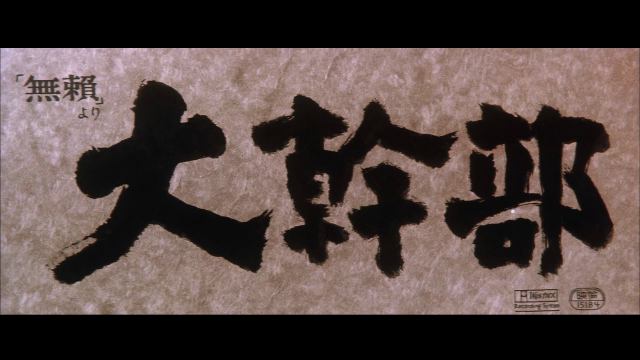
 Kino 893