
Each time I fire up another movie from the Outlaw series, I’m struck by the question of  how I’m going to find something meaningful to comment on in a review that I haven’t already said about one of the previous films. Then Outlaw: Black Dagger (1968) did something unexpected: it commented on its recycling of the same actors over and over again.
Category: Reviews
Review: Stray Cat Rock: Delinquent Girl Boss (1970)
Continuing a dive into Meiko Kaji’s past performances I decided to check out Delinquent Girl Boss (1970), the first movie in the Stray Cat Rock series. Initially inten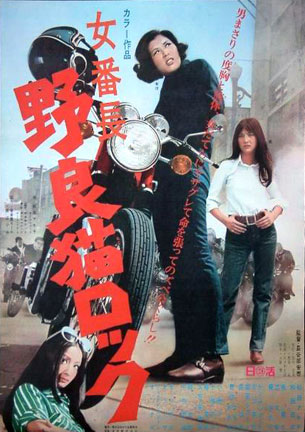 ded as a star vehicle for the popular singer Akiko Wada, from the second film onwards it would be Kaji who scored top billing, and Wada soon disappeared from the cast. Going into the film, I expected it to be a case of Meiko Kaji outshining the intended star – after all, by this point I had already been impressed with her performance in Lady Snowblood and was starting to see why she’s held in such high regard by genre movie fans. I figured that maybe Wada wasn’t able to carry the movie the way Nikkatsu wanted, but I couldn’t have been more wrong.
Continue reading “Review: Stray Cat Rock: Delinquent Girl Boss (1970)”
Review: Outlaw: Goro the Assassin (1968)
Four films in and the Outlaw VIP series is beginning to creak. As I noted in reviews of 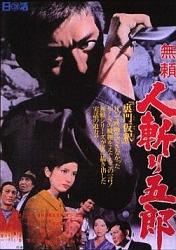 previous instalments, Nikkatsu put out no less than six Outlaw movies starring Tetsuya Watari in 1968 and 1969. The fourth, Outlaw: Goro the Assassin (1968), sees the titular anti-hero Goro Fujikawa as a drifter without a yakuza family who gets involved in yet another feud involving local criminals and innocent civilians.
Bonus Review: The Fast and the Furious: Tokyo Drift (2006)
If I had to pick a movie as a guilty pleasure, I might choose The Fast and the Furious: Tokyo Drift (2006) – except I don’t feel guilty at all, because I love this movie. The third 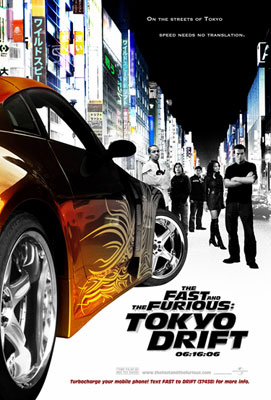 instalment in the now massive, globe-trotting franchise, back in the mid-2000s the future of the series seemed in jeopardy: Vin Diesel had left after one film, Paul Walker after the second. Tokyo Drift was essentially a Hail Mary soft reboot with an all-new cast that transplanted the action to Tokyo, and swapped street races for suitably Japan-inspired drifting.
While the focus of this blog is, and will remain, on Japanese cinema, my tastes are eclectic. I love all kinds of movies, and sometimes, I’ll feature them here if they have some suitable hook – maybe they’re set in Japan, or from a Japanese director working on a foreign production, or it’s a remake of a Japanese movie. In the case of Tokyo Drift, I’m using the location and a scenery-chewing appearance by Sonny Chiba as an excuse.
Continue reading “Bonus Review: The Fast and the Furious: Tokyo Drift (2006)”
Review: Blind Woman’s Curse (1970)
The inimitable Meiko Kaji’s first starring role, Teruo Ishii’s Blind Woman’s Curse (1970) is an aggressively strange yakuza movie with a touch of the supernatural. It’s so strange the Arrow Video release calls it ‘delerious’ multiple times on the cover, and for once, that doesn’t feel unfair – from the bold use of colour to the costuming to the off-kilter horror elements, the film is a phantasmagoric treat.
Yakuza Zero (A Kino 893 x TGLG Review)
It is not my intention, still early in the run of this blog on Japanese cinema, to branch too  wildly into other areas. That said, I do think there are other, relevant things that could be discussed: American re-edits or remakes of Japanese productions, books on the subject, and videogames that draw from the history of film. There’s one series that’s particularly dear to me: SEGA’s Yakuza (龍が如く/ Ryū ga Gotoku). First launching in Japan in 2005 and 2006 in the West, the series transplants recognisable yakuza movie tropes onto a long-running videogame franchise. It’s easy to see the influence Japanese cinema of the ‘60s and ‘70s has had on it, from casting Tetsuya Watari (star of the Outlaw VIP series) as the protagonist’s yakuza mentor Shintaro Kazama, to the dramatic, freeze-frame splash screens that list the various characters’ names, ranks, and affiliations – a stylish technique ripped straight from Kinji Fukasaku’s Battles Without Honor and Humanity.
2017 has seen the belated, but extremely welcome, Western release of Yakuza Zero (originally launching in Japan in March 2015). Set in 1988 at the height of the Japanese Bubble Economy, the game is both a prequel to the series and the first non-spin off released on the PlayStation 4, making it an excellent jumping on point for newcomers.
Review: Lady Snowblood 2: Love Song of Vengeance (1974)
Watching the first Lady Snowblood, I found it a fun, throwback exploitation movie with a 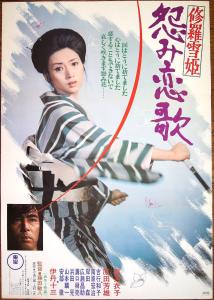 satisfying take on the rampage of revenge trope. It was also my introduction to Meiko Kaji, an ice cold chanbara beauty, categorically not playing a damsel in distress or love interest; in other words, playing a role quite unlike most Japanese women on film. There was something indirectly subversive about a woman slicing through the gang who’d wronged her family, and in Lady Snowblood 2: Love Song of Vengeance (1974), I was looking forward to seeing that subversive streak taken a step further.
Continue reading “Review: Lady Snowblood 2: Love Song of Vengeance (1974)”
Review: Ghost in the Shell (1995)
I first saw Ghost in the Shell (1995) in the late ‘90s, on a probably-rented VHS, with the American dub (which, to my recollection, actually held up as 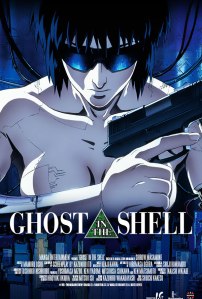 one of the better dubs I’ve heard, though I haven’t tested that in years). Since then I’ve revisited it several times, with the original Japanese audio, both before and after I learned to speak the language. I recently had the opportunity to see it in a cinema for the first time, which presents a perfect moment to discuss the film here.
Review: Lady Snowblood (1973)
I’ve said it repeatedly already, but it’s still relevant: beyond just wanting to widen my  horizons on Japanese cinema, one of the main reasons I want to watch films from the ’50s, ’60s, and ’70s is their outsized influence on later filmmakers. Quentin Tarantino is outspoken on the influence Japanese cinema has had on his pictures, with Kill Bill in particular owing much to Lady Snowblood (1973).
Review: Branded to Kill (1967)
It didn’t take much research into Japanese film before Seijun Suzuki’s name came up. 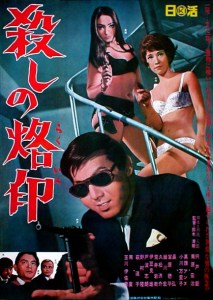 Specifically, it was an anecdote about his film Branded to Kill (1967): a film so far removed from his orders to create a B-movie about a hitman, to fill out the back half of a double bill, that he was promptly fired by the studio. The movie is now regarded as an avant-garde masterpiece, and I knew that I had to see it.
 Kino 893