
Stop me if you’ve heard this one before: a small town cop arrives in the big city to help solve a crime with links to his home. Except in Kinji Fukasaku’s Doberman Cop (1977), that rural detective is Shinichi “Sonny” Chiba, and he rolls into Tokyo’s Kabukicho entertainment district with his straw hat and delightful piglet in tow.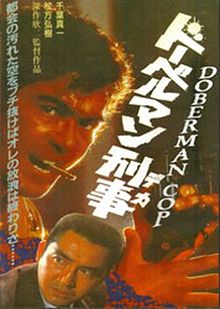 What follows is a remarkable police thriller closer in feel to an ‘80s action film that Fukasaku’s earlier jitsuroku work – more Lethal Weapon than Battles Without Honour and Humanity. Only very loosely based on the manga of the same name by ‘Bronson’, it’s an eclectic mix of action, comedy, martial arts, and grisly crime drama; a film that should result in complete tonal whiplash, but somehow comes together into an off kilter but satisfying, cohesive whole.
Month: Jun 2017
Review: Cops vs. Thugs (1975)
Back in the early 2000s, Kinji Fukasaku’s Battle Royale was probably one of the first live action Japanese films I ever watched. Its popularity helped highlight other Japanese cinema, and a for while, Japanese films were synonymous with shocking, violent pieces like Battle Royale or the work of prolific director Takashi Miike – slapstick exploitation like Ichi the Killer or the truly bizarre Happiness of the Katakuris. It moved the conversation away from the ubiquitous J-horror of the late ‘90s, led by Ring and Grudge and their imitators. Of course, there’s much more to Japanese cinema than that, but it’s where I got my start. It wasn’t until many years later that I became interested in throwback yakuza movies of the 1970s, largely off the back of my interest in SEGA’s Yakuza/Ryū ga Gotoku series. The title I kept seeing referenced as Japan’s equivalent of the Godfather trilogy was Battles Without Honour and Humanity, directed by none other than Kinji Fukasaku.
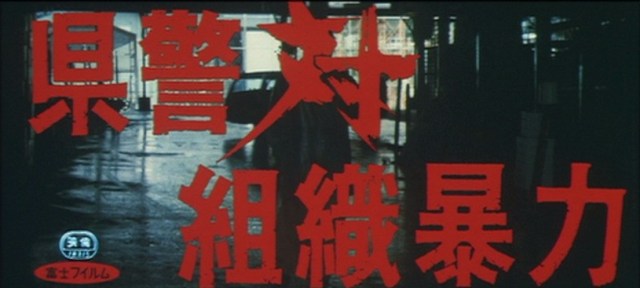
That series remains perhaps the most well-known example of the “jitsuroku” style of yakuza filmmaking – ‘actual record’ or ‘true document’ films, based on or inspired by real stories or newspaper headlines; films that didn’t depict the yakuza as masculine heroes on the wrong side of the law, but focused on petty squabbles, violence, and a nihilistic take on Japan’s organised criminals. It was between the five-film Battles Without Honour and Humanity saga and its follow-up, New Battles Without Honour and Humanity, that Toei’s top brass brought Fukasaku in to direct Cops vs. Thugs (1975). Not content to deconstruct the yakuza alone, the film drags the police and civic leaders into a fascinating quagmire of corruption.
Review: Female Prisoner Scorpion: Jailhouse 41 (1972)
The Female Prisoner Scorpion and Lady Snowblood film series present a similar  challenge: at the end of the first film in each, Meiko Kaji’s protagonist has found her revenge, so how will the series continue? I suspected Female Prisoner Scorpion: Jailhouse 41 (1972) might be a sequel in name only, starring Kaji and her titular, vengeful protagonist in a new scenario, rather like the Outlaw films of the 60s. Instead, Jailhouse 41 picks up where the first film left off, with a brutal reminder that Scorpion’s vengeance is not complete: the prison warden yet lives.
Continue reading “Review: Female Prisoner Scorpion: Jailhouse 41 (1972)”
Intermission
It’s been a hectic week here in the UK and my usual Friday movie review is running behind schedule. Rest assured that I’ve got a couple of Japanese cult classics coming up, with Kinji Fukasaku’s Cops vs. Thugs and the second Female Prisoner Scorpion movie, Jailhouse 41.
In the meantime, why not read up on how the election is going down with British expats in Japan?
Kino 893 will resume normal service soon!
Review: Lone Wolf and Cub: Sword of Vengeance (1972)
Lone Wolf and Cub was always one of those series that I knew existed, but had never  seen; I knew it better from the voluminous stacks of manga sitting unread in my local comic shop than as a movie series. Unlike some of the films I’ve reviewed here that only received a wider release outside of Japan very recently, Lone Wolf and Cub: Sword of Vengeance (1972) did actually get an international release back in the 1970s, but it’s probably better known under the title Shogun Assassin from 1980. That film, a dubbed re-edit of the first two films in the Lone Wolf and Cub series, apparently only uses 11 minutes of footage from Sword of Vengeance. After watching it, I can guess why, and only hope the rest of the series – presented by Criterion in a wonderfully illustrated six-film set – offers some rapid improvement.
Continue reading “Review: Lone Wolf and Cub: Sword of Vengeance (1972)”
 Kino 893